
What Happens to Your Body When You Hold a Yoga Pose for 3 Minutes
Aug 12, 2026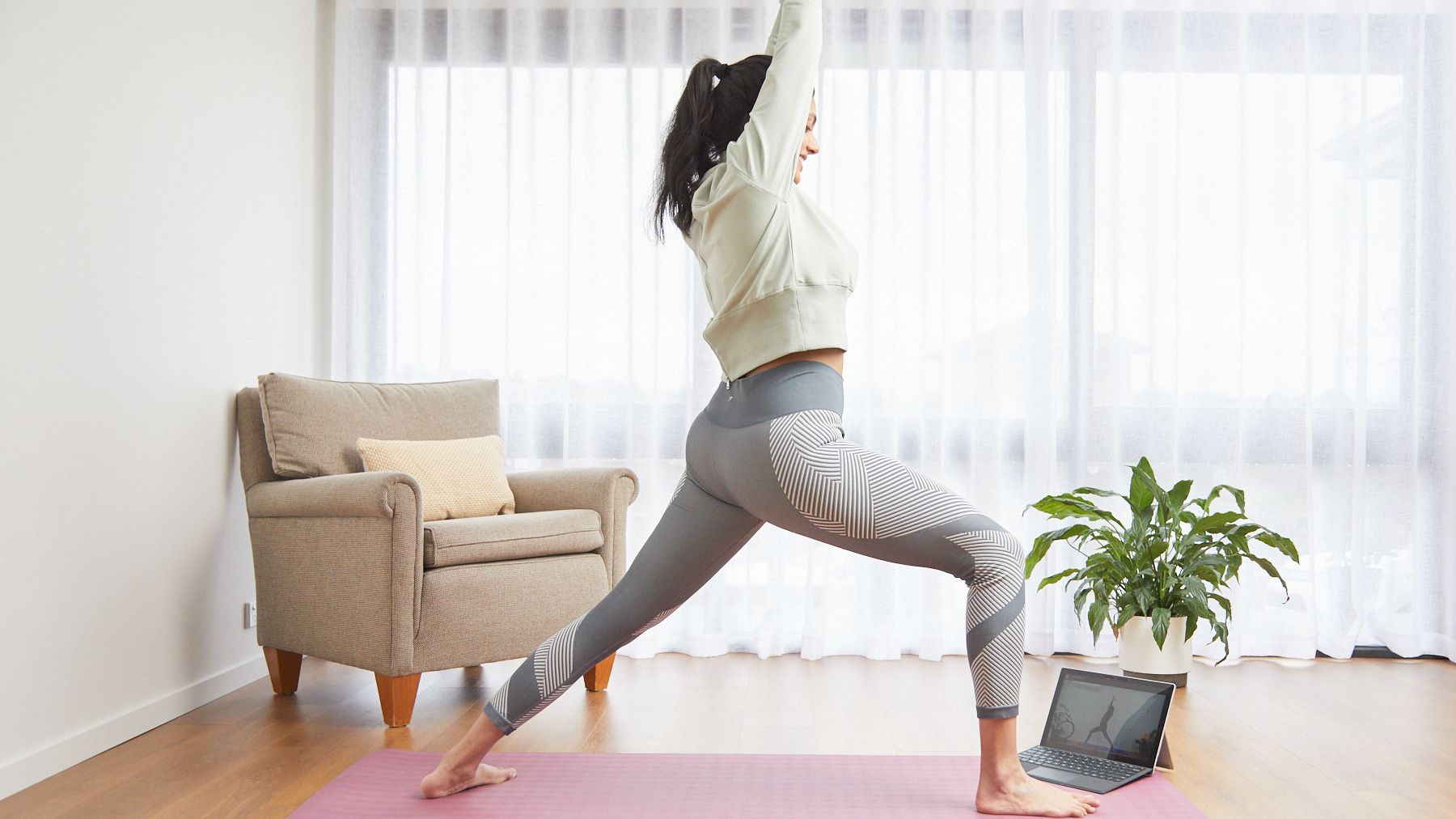
I taught something for the first time in my classes last month since I started teaching yoga almost two decades ago. For the past six weeks I have been asking my students to stay.
Stay in Warrior II. Stay in a squat. Stay in a balance. Stay in a stretch.
For three minutes.
We have always used longer holds in my classes, but never for this long. I wanted to spend close to two months exploring them properly, rather than dropping a long hold into class occasionally and moving on.
I hesitated because I knew it would take my students well outside their comfort zones. These are mostly women over 35, with some well into their sixties and seventies. I wondered whether three minutes would feel excessive. Whether they would hate it. Whether I would spend eight weeks watching the clock while a room full of students silently reconsidered their choice of yoga teacher.
Instead, the response really surprised me. They all held the poses, stayed past the point where they wanted to leave, and came out the other side saying they loved it. And I am happy to report, I am still their yoga teacher!
I watched women in their forties, fifties, sixties, and seventies stay in Warrior II for three minutes. I watched the leg shakes, the wobbling, the look of uncertainty and sometimes frustration. And then I watched something settle. Not the difficulty, that was still there, but the relationship to it. What followed was a joy, the realisation that the body was stronger and more capable than they had ever given it credit for.
All they had to do was stay long enough to witness it.
The shift in my own practice
I am a vata type, which in Ayurvedic terms means I am naturally wired for movement, novelty, and change. A flowing practice has always been what my nervous system reaches for first. It is what feels like me.
But a month into teaching these long holds, something changed on my own mat.
I rolled out with every intention of flowing through a vinyasa practice. But somewhere in the first few minutes, my practice started to feel strangely unsatisfying. I was moving but I was not feeling anything. I was not feeling that tension between effort and ease that I had grown used to from holding poses longer. It was an odd sense of not being fully in my body. I found myself questioning what moving through these familiar shapes so quickly was actually giving me.
So I stayed in the first pose instead. Then flowed to the next one and stayed. And the next.
What fascinated me was that I was not making myself practice stillness because I thought I should. I wanted to stay. Somewhere during those six weeks, my relationship with stillness had changed. Which raised a question I had not really considered when I chose this theme.
What exactly have we been training when we spend three minutes in a yoga pose?
Because clearly, it is not only muscle.
What is happening in the body when you hold a pose long enough to matter
Your body is made of two kinds of tissue that respond to load on completely different timescales.
The first is muscle. Muscle responds quickly. Within the first thirty seconds of a hold you can feel it working, and protesting, depending on how much you are loading it. Most exercise targets muscle and most people think that is all there is to it.
The second is connective tissue. The tendons that connect muscle to bone. The ligaments that hold your joints together. The fascia that wraps around everything and gives your body its structural integrity and its shape. This tissue is slow by design, and it responds to sustained, unhurried load held long enough that it has no choice but to adapt.
Here is an important distinction worth making before we go further. Connective tissue does not sit dormant for two minutes and then suddenly switch on. It begins responding to load immediately, from the very first second of a hold. What it cannot do is accumulate the sustained stimulus it needs for meaningful structural adaptation in less than two to three minutes. Brief holds register. They simply do not produce lasting change in the deeper structures in the way that longer holds do.
Think of cold butter. If you stab at it repeatedly nothing much happens. Apply gentle sustained pressure and it gradually gives way. Your connective tissue works the same way. Brief effort bounces off it. Sustained load changes it.
Research suggests that around the two to three minute mark something begins to shift more meaningfully. The muscle response settles and the load starts transferring more significantly to the deeper structures, the joint capsule, the ligaments, the fascial layers around the joint. These structures begin responding to the sustained pressure in a way that builds structural resilience over time. The exact threshold varies between individuals, tissues, and the level of load, but the general principle is well supported by the research on connective tissue biomechanics.
There are two kinds of holding and they do different things.
A strength hold, warrior pose held for three minutes, a plank or a bridge pose sustained past the point of comfort, creates what is called isometric loading in the tendons and ligaments. A sustained muscular contraction without movement that tells the structural tissue to maintain and strengthen itself. Physiotherapists increasingly use sustained isometric holds as a key intervention in tendon rehabilitation for exactly this reason. The tissue responds to that specific demand in a way that briefer loading does not replicate as effectively.
When your legs are burning in a long held warrior and everything in you wants to come out, that is the signal your connective tissue has been waiting for. Not the first thirty seconds. That moment. Past the point where it stopped being comfortable.
A passive stretch held for three to five minutes, a deep hip opener, a long forward fold, takes the muscle out of the equation entirely and loads the deeper structures directly. The joint capsule, the ligaments, the fascial layers respond through a process of gradual deformation under sustained gentle load. You cannot rush this any more than you can rush a bone knitting. The tissue has its own timeline.
This is also where yoga does something that conventional exercise, including weight training, tends not to. Many gym based programs tend to favour the middle ranges of joint motion, the ranges where the muscle is strongest and most in control. Long held yoga poses load the connective tissue at the end ranges of joint motion, the positions where the joint capsule and ligaments become the primary restraint. These structures need to be stressed at their edges to stay organised and resilient. Without that, they gradually lose their capacity to maintain joint integrity at the ranges where daily life and unexpected demands actually find them.
Staying with discomfort and what it actually does to the brain
A psychiatrist I once read, made an observation about anxiety that I have thought about in relation to this practice ever since. He said that anxiety generates an urge to escape, to run from the thing producing the discomfort. When you run, two things happen. The immediate discomfort reduces, which reinforces the running as the solution. And you never discover that the anxiety would have reduced on its own if you had stayed, because you left before that could happen.
When you stay, something different happens. The anxiety peaks. It is uncomfortable. And then it begins to reduce on its own, because anxiety is a wave, not a permanent state. The nervous system cannot sustain peak activation indefinitely. It always comes down. When you stay long enough to feel it come down without having done anything to make it reduce, you learn something the running prevents you from learning. That the discomfort has no permanent hold on you. That it passes. That you are capable of being with it without being destroyed by it.
Every long hold is a micro version of this. Past the first minute, when the impulse to leave is strongest, is precisely where the learning lives. The student who stays in warrior three past the burning, past the wobble, past the moment where everything wants to come out, is practicing the same fundamental skill. Staying with discomfort long enough to discover that it changes without requiring action.
And just as with clinical exposure work, the repeated experience of staying and discovering that the discomfort passes gradually reduces the nervous system's sensitivity to that discomfort. The chair pose that felt unbearable in week one feels more manageable in week four. Not only because the connective tissue has adapted, but because the nervous system has learned from repeated experience that it does not require escape. It passes. It always passes.
This is attention training as much as physical training. Every time you stay past the impulse to leave, you are training the part of the brain responsible for executive function and impulse regulation to override the default toward novelty and relief. Consistent practice over weeks begins to produce changes in attentional capacity. The ability to sustain focus without being pulled away by every competing stimulus. Which is exactly what I experienced that morning when the vinyasa flow felt like it was no longer giving me what I needed.
Why this matters more in perimenopause than at any other stage of life
The brain in perimenopause is navigating something specific that makes everything above more relevant rather than less.
The default mode network is the brain's background processing system, responsible for mind wandering, self referential thought, rumination, and the mental chatter most people experience as the baseline of their inner life. In perimenopause, the hormonal fluctuation, sleep disruption, and neurological changes of this transition increase default mode network activity. Rumination becomes more persistent. Anxiety shows up in new ways. The difficulty of quietening the mental noise intensifies even when circumstances have not changed dramatically.
You might recognise it as the 3am thoughts that will not stop. The disproportionate reaction to something small that surprises even you. The low level hum of mental noise that seems to have no obvious source but is just there, running in the background, making everything slightly harder than it used to be. Many women describe this as feeling less like themselves without being able to name exactly why.
Sustained stillness practice directly addresses this through the same mechanism the long hold trains in any body at any age. Not by suppressing thought or forcing calm but by training the attentional system to sustain focus long enough that the default mode network's background noise becomes less dominant. Over weeks of consistent practice this produces a measurable shift in the baseline quality of mental experience. Less reactive. More present. More able to choose where attention goes rather than being pulled by whatever is loudest.
The students who have described feeling less reactive to life after two months of this practice are not experiencing a placebo effect. They are experiencing a neurological adaptation produced by consistent exposure to sustained stillness, in a brain that was already working harder than usual to manage its own noise.
There is also the physical dimension specific to this life stage. As oestrogen declines, so does its protective effect on connective tissue. Collagen synthesis decreases. Joints become less resilient. The structural scaffolding of the body that oestrogen was quietly maintaining needs a new signal to keep doing its job. That signal is mechanical load. Sustained, consistent, appropriate load applied to the connective tissue in a way that tells the body's collagen producing cells to keep building and remodelling.
Collagen supplements have some evidence behind them, particularly for skin. But supplements provide the building materials. Mechanical loading provides the signal that tells the body where and what to build. Without the signal, the materials do not get directed toward the structures that need them most. Your consistent practice is the signal. The long holds, both strength and passive, are what tell the body to keep building the structural resilience that oestrogen used to protect automatically.
The honest timeline
Connective tissue remodels slowly. Research suggests a minimum of eight to twelve weeks of consistent practice for meaningful structural change to begin, and for some tissues and some people the timeline is longer. The flexibility gains you notice week to week are largely your nervous system accommodating the new positions, which is real and valuable, but it is not the same as the tissue itself having changed. The tissue changes come later, quietly accumulating with consistency over months.
The same is true of the neurological adaptations. The attentional capacity, the reduced default mode network activity, the growing capacity to stay with discomfort rather than escape it, these changes do not happen in a single session or a single week. They accumulate slowly, in the same quiet way the connective tissue remodels.
This is why consistency matters more than any single session. And why two months of practice produces something one month cannot. You are not just doing yoga. You are training two systems simultaneously, the structural and the neurological, both of which require time and repetition to change in ways that last.
A practice that predates the research
Long holds are not a new idea. The idea of steadiness is deeply embedded in yoga.
Traditional hatha yoga, which existed long before vinyasa and power yoga and every other modern style arrived, was built around extended holds. Poses were held longer as a way to learn how to become steady enough that the body stopped demanding quite so much attention from the mind. The instruction was simply to stay and breathe. To find what was there when the movement stopped.
Much of the yoga we see today keeps us moving. Vinyasa. Power yoga. One pose becoming another, then another. There is always somewhere new to go. I understand the appeal because I am drawn to it too. In Ayurvedic terms, movement, change and novelty are qualities I recognise very strongly in my own Vata nature. Give me a flowing sequence and my mind has plenty to play with.
Stillness however, asks something completely different of us.
When you stay in Warrior II for three minutes, there is no next pose arriving to rescue you from the current one. Eventually the novelty disappears. The question is no longer what comes next?
It becomes what is happening now?
And eventually, what is my mind doing while my body stays here?
What my students taught me
I want to come back to where I started. The women in their forties, fifties, sixties, and seventies holding warrior poses for three minutes. The leg shakes. The wobble. The uncertainty settling into something else.
What settled was not the difficulty, it was still there. What settled was the relationship to it.
That is the thing that happens past the two minute mark that I did not fully anticipate when I planned these classes. The poses did not become easier, but the students inside them became different. More willing to be with what is there rather than manage it, escape it, or wait for it to be over.
And that capacity, built in the body through consistent physical practice, does not stay on the mat.
It shows up in the difficult conversation that you stay present for rather than deflecting. In the anxious thought that you observe rather than chase. In the moment of physical discomfort in daily life that you meet with curiosity rather than alarm. In the accumulated sense, over months of practice, that you are more capable of being with your own experience than you previously believed.
The wellness industry has a very specific story about ageing bodies. That they are declining, fragile, in need of increasingly intense protocols to maintain what is being lost. Some of that conversation is legitimate.
But my students have demonstrated something the wellness industry rarely says.
A body that has been consistently, patiently, and intelligently practiced over years is not a lesser version of a younger body. It is a different kind of capable. One that knows how to stay. How to breathe inside discomfort. How to find what is there when the movement stops.
All they had to do was stay long enough to experience it.
If you want to explore what this kind of practice feels like in your own body, I would love to have you join us. We practice online, which means wherever you are, there is a mat waiting.
I know online yoga is not for everyone, but if you would like to try it for free for 14 days, lets chat.
I also write more personal essays on how I am navigating this phase of my life, my unbecoming and the bigger questions underneath. You can find me here: https://substack.com/@shahrean
Bring some HAPI to your inbox.
Receive exclusively curated content on Yoga and Ayurveda practices to spark joy, inspire action and live with purpose.
.